Disclosure in Accord with the TCFD Recommendations
Introduction
The KONOIKE Group recognizes that climate change is an important issue affecting the global environment, humanity, and corporate activities, and is actively promoting activities to mitigate global warming in order to contribute to the realization of a sustainable and prosperous society. The Group announced our endorsement of the TCFD recommendations in June 2022.
The TCFD recommendations suggest four items for disclosure: Governance, Strategy, Risk Management, and Metrics and Targets. The Group will continue to make efforts in line with these items and further enhance the disclosure of information.
1.Governance
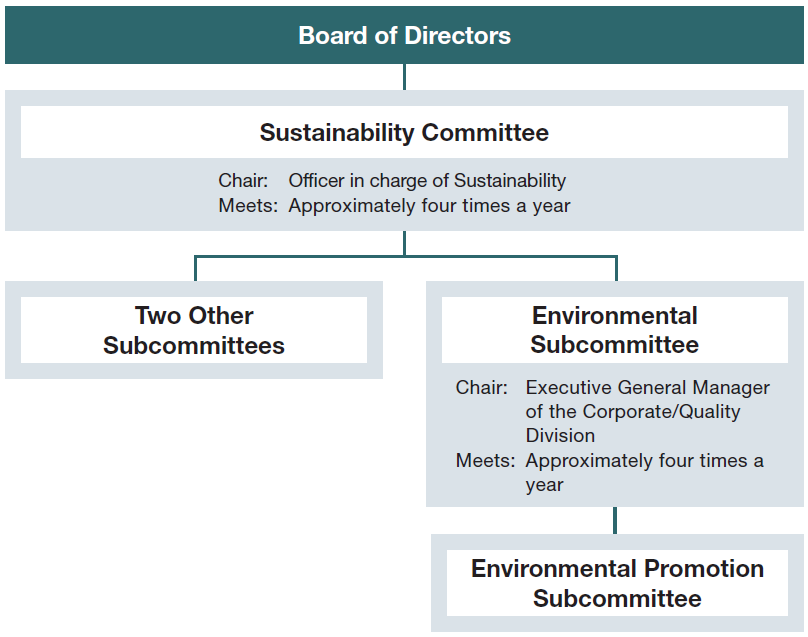
The Sustainability Committee has been established as an advisory body to the Board of Directors, to discuss individual sustainability issues, including matters related to climate change, under the supervision of the Board.
The Board of Directors reviews evaluation results from the Sustainability Committee to set non-financial environmental targets in line with the KONOIKE Group 2030 Vision and Medium-Term Business Plan, and monitors progress toward those goals.
The Environmental Subcommittee operates under the Sustainability Committee and shares information on the status of environmental initiatives at each headquarter every quarter based on environmental data from these headquarters. The subcommittee then discusses specific solutions for each issue, including those for climate change. The subcommittee ensures fairness and objectivity by inviting an outside expert, among other measures.
2.Strategy
We identified risks and opportunities in our business resulting from the progression of climate change and developed a medium- to long-term strategy. Identified risks and opportunities are outlined in the table below.
(1) Climate-Related Risks and Opportunities
| Category | Impact | Timeline | Action Policy | ||
|---|---|---|---|---|---|
| Risk | Transition | Policies and regulations | Possibility of worsening business performance due to increased tax burden associated with the introduction of carbon tax, etc. | Medium-term | We finished switching all contracted electricity for our facilities to CO2-free electricity by the end of FY3/2025. We will continue efforts to reduce emission intensities by improving operational efficiency and introducing low-carbon technologies |
| Technology | Policy changes and stricter laws and regulations may increase the need to introduce new technologies that contribute to low-carbon emissions and/or increase the cost of replacing or installing new facilities | Short/medium-term |
|
||
| Physical | Acute | Increasing number of disasters caused by climate change, such as typhoons and river flooding, could damage our locations and jeopardize business continuity | Long-term | Evolve our business continuity plan (BCP: construction for disaster response, relocation, power and water outage countermeasures, etc.) | |
| Chronic | Potential deterioration in productivity and hiring difficulty due to hot working environments caused by rising temperatures | Long-term | Taking measures to reduce workload in hot environments (e.g., cool air blowers, neck coolers) to maintain occupational health and at the same time promoting labor savings through the introduction of technology and DX | ||
| Opportunity | Resource efficiency | Potential to expand business opportunities through better pitching to customers by strengthening environmental measures such as CO |
Short/medium-term | Improving operational efficiency and productivity in manufacturing and service provision processes, promoting modal shifts and joint delivery, etc. | |
| New markets | Potential to enter business domains and areas where market expansion is foreseeable in a society where CO |
Short/medium-term | Work to identify growth areas in each industry, gather information, and expand management resources to capture opportunities | ||
(2) Scenario Analysis
a. Scenario analysis (qualitative)
The KONOIKE Group analyzed potential risks and opportunities facing the Group in two scenarios: one in which temperatures increase approximately 2℃ (1.5℃) compared to pre-industrial revolution temperatures due to progress in global decarbonization efforts, and the other in which temperatures rise 4℃ or more due to no progress in these efforts. We analyzed impacts (risks and opportunities) of these two scenarios based on group-wide, function-specific, and industry-specific factors. In addition, we consider the direction of actions necessary for sustainable business in either of the two scenarios in our Action Policy.
(Overview)
- Group-wide factors consider important matters such as disaster risk at our own sites as well as CO2 emission reduction measures related to Logistics-Related and Environment-Related recycling that emit high levels of CO2. Failure to address these issues may result in reduced business with customers, whereas if handled appropriately, may lead to increased business opportunities. As such, we consider these to be the most important factors to focus on.
- Specific factors are divided into two categories: logistics-related and contracting-related. During customer supply chain disruptions, it is key to forecast and grasp their increasing outsourcing needs. These needs include improving operational efficiency and introducing low-carbon vehicles in Logistics-Related, improving productivity, and thereby reducing waste in the manufacturing process, as well as introducing equipment that contributes to low carbon emissions in Contracting-Related.
- Other industry-specific factors are noted in the table below.
| Category | 2℃ (1.5℃) Scenario | 4℃ Scenario | Action Policy | |
|---|---|---|---|---|
| (Notes) | Assumes a world in which GHG emission are reduced and rising temperatures are controlled (i.e., mainly transition risks surface). [Major Events and Assumptions]
|
A world in which current business continues as usual (BAU) and no measures are taken to reduce GHG emissions (i.e., mainly physical risks materialize) [Major Events and Assumptions]
|
Policies on how the KONOIKE Group will reduce risks and seize opportunities considering what would happen in either the 2℃ or the 4℃ scenarios. | |
| Group-Wide Factors | [Risks]
|
[Risks]
|
[2℃]
|
|
| Special Factors by Functions | Logistics-Related | [Risks]
|
[Risks]
|
[2℃ and 4℃] Reduce energy consumption by improving operational efficiency (loading efficiency, actual vehicle rate, and actual operation rate). Acquire capital resources through opportunities such as for modal shift and reverse logistics, establish a system to introduce next-generation technologies low-carbon as they become widely available. Work to maintain and build partnerships with customers to partially collect on revised installation costs in the diffusion phase of next-generation technologies. |
| Production and Contracting Services-Related | [Risks and Opportunities] Introduction of low-carbon technologies in production facilities (increased costs but appeals to customers) |
[Risks and Opportunities] Decline in productivity and increase in difficulty of recruitment due to worsening of hot climates. Increase in customer demand for outsourcing. |
[2℃]
|
|
| Special Factors by Industry | Steel-Related | [Risks]
|
[Risks] Negative impacts on operations due to water shortages caused by rising temperatures |
[2℃]
|
| Engineering-Related | [Opportunities]
|
[Risks]
|
[2℃]
|
|
| Food | [Risks] Stricter CFC emission regulations and increased equipment replacement costs |
[Risks]
|
[2℃] Generally the same as group-wide factors. Aim to expand business opportunities with customers by improving operational efficiency and switching to low-carbon vehicles in Logistics-Related while streamlining production processes and introducing production equipment that contributes to low carbon emissions (reducing waste) in Contracting-Related. |
|
| Food Products | [Risks]
|
[2℃] Generally the same as group-wide factors. Aim to expand business opportunities with customers by improving operational efficiency and switching to low-carbon vehicles in Logistics-Related while streamlining production processes and introducing production equipment that contributes to low carbon emissions (reducing waste) in Contracting-Related. |
||
| Life-Related Business | [Opportunities]
|
[Opportunities] Increase in demand for HVAC equipment due to rising temperatures |
[2℃] Expand installation services (in-house use and external sales) of solar power generation and other energy-saving equipment, mainly through the Techno Service Osaka and Soka Offices. Seize business opportunities for clean energy in manufacturing and transportation. |
|
| Medical-Related | [Opportunities] Increase in equipment and materials, as well as their handling, due to the recycling and reuse of disposable medical equipment and materials, etc. |
[Opportunities] Increase in disasters → Potential expansion in supplies and services for disaster relief |
[2℃] Utilize the momentum for resource conservation and recycling to promote development of services and other areas for expanding the range of commercial products we handle. |
|
| Airport-Related Business | [Risks]
|
[Risks] Impact on human resource securement due to deteriorating working environments from rising temperatures and frequent extreme weather events |
[2℃] Establish an efficient operation system and improve working environments by introducing decarbonized vehicles and promoting automated and unmanned vehicles, reflecting the infrastructure development policies and plans of each airport. |
|
b. Scenario analysis (quantitative)
The KONOIKE Group estimated the impact amount of the carbon tax on the risks and opportunities identified in Table (1) above by referencing the World Energy Outlook 2021 of the International Energy Agency (IEA). Please note that this analysis only provides general ideas in attempts to make a rough estimate of initiatives possible at this time. Other risks and opportunities may also have positive or negative impacts. However, information for our analysis is insufficient at this time, and we have not yet been able to quantitatively calculate impact amounts.
Carbon Tax Impact Analysis Results
| Cases Considered | 2030 | 2050 |
|---|---|---|
| Impact Amount | Impact Amount | |
| No efforts taken (BAU) | -¥3,600 to -¥4,200 million | -¥5,000 to -¥9,200 million |
| Group goals achieved | -¥2,300 to -¥2,700 million | No impact |
(Note) These figures were calculated based on the following assumptions by multiplying expected CO2 emissions for each year by the carbon prices in Reference 2.
(Reference 1) Explanation of Each Case
| Cases Considered | Details |
|---|---|
| No efforts taken (BAU) | Case in which FY3/2024 emission intensities remain roughly the same as in 2030 and 2050 |
| Group goals achieved | Case in which company goals (2030: 35% reduction (vs. FY3/2019), 2050: carbon neutrality) are achieved |
(Reference 2) Carbon Price Assumptions
(Unit: yen/t-CO2)
| Assumptions | 2030 | 2040 | 2050 |
|---|---|---|---|
| STEPS*1 | 18,203 | 19,568 | 20,478 |
| NZE*2 | 21,237 | 31,096 | 37,923 |
- Stated Policies Scenario: A scenario incorporating current national government plans from all countries, including policy initiatives already announced and implemented around the world, as set out in WEO2023.
- Net Zero Emissions by 2050 Scenario: A scenario in which temperatures rise no more than 1.5˚C from before the industrial revolution, as set in WEO2023.
(Note) Carbon prices were converted at ¥151.69 to $1 USD, using EU values for STEPS and values for advanced economies with net zero targets for NZE.
(Reference 3) 2030/2050 Results and CO2 Emission Assumptions
- We calculated the projected FY3/2031 CO2 emissions for the KONOIKE Group under the assumption that we achieve the 2030 Vision. These calculations were based on the CO2 emissions and emission intensity of each business segment in FY3/2024. We also estimated sales in 2050 on the assumption that the Group grows in line with Japan’s overall growth rate (CAGR 1%) from 2030 to 2050.
- 2030 and 2050 CO2 emissions were calculated based on the assumptions for each case in Reference 1.
3.Risk Management
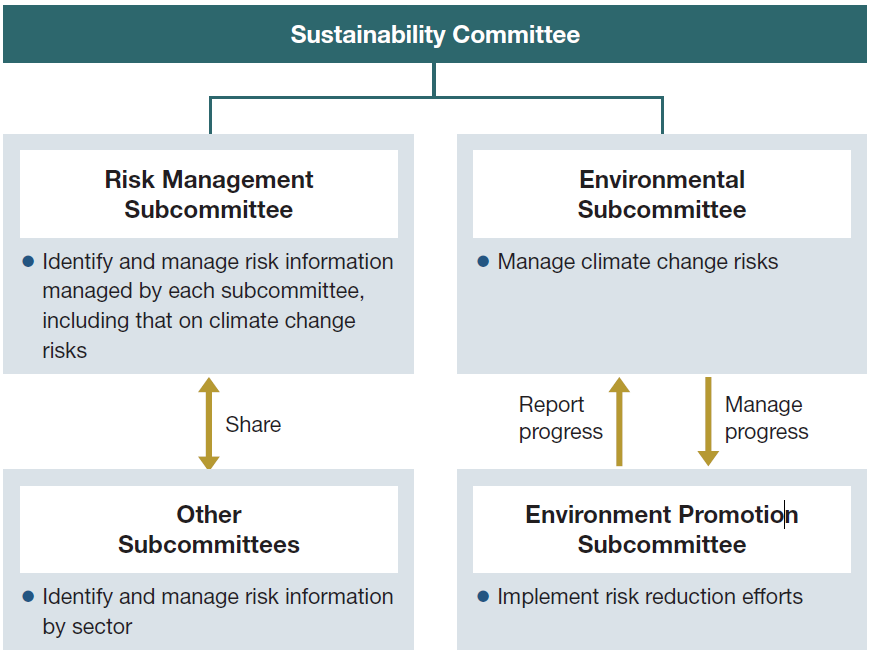
Information on group-wide risks is obtained and managed by the Environmental Subcommittee for climate-related risks, and by the Risk Management Subcommittee (Chair: officer in charge of risk management for all Group companies) for other risks by consolidating information from the various subcommittees.
The Group identifies and assesses climate-related risks and opportunities in two stages. First, the administrative departments (environment, corporate planning, general affairs, finance, and accounting) review the opportunities deeply relevant to the KONOIKE Group and assess the timeline, impact level, and likelihood. Next, the Environment Promotion Subcommittee, which operates under the Environmental Subcommittee, identifies likely opportunities for each business unit and evaluates identified items using the same criteria. The administrative departments consolidated such results, grouped and organized the items, and compiled the findings into the table above.
The Environment Promotion Subcommittee, under the Environmental Subcommittee, manages climate-related risks and opportunities, and receives regular reports from each business unit on progress in addressing risks and capturing opportunities. The Environment Promotion Subcommittee continually reviews and updates risk and opportunity items based on these reports. The same information is then reported to the Environmental Subcommittee and subsequently to the Risk Management Subcommittee.
4.Indicators and Targets
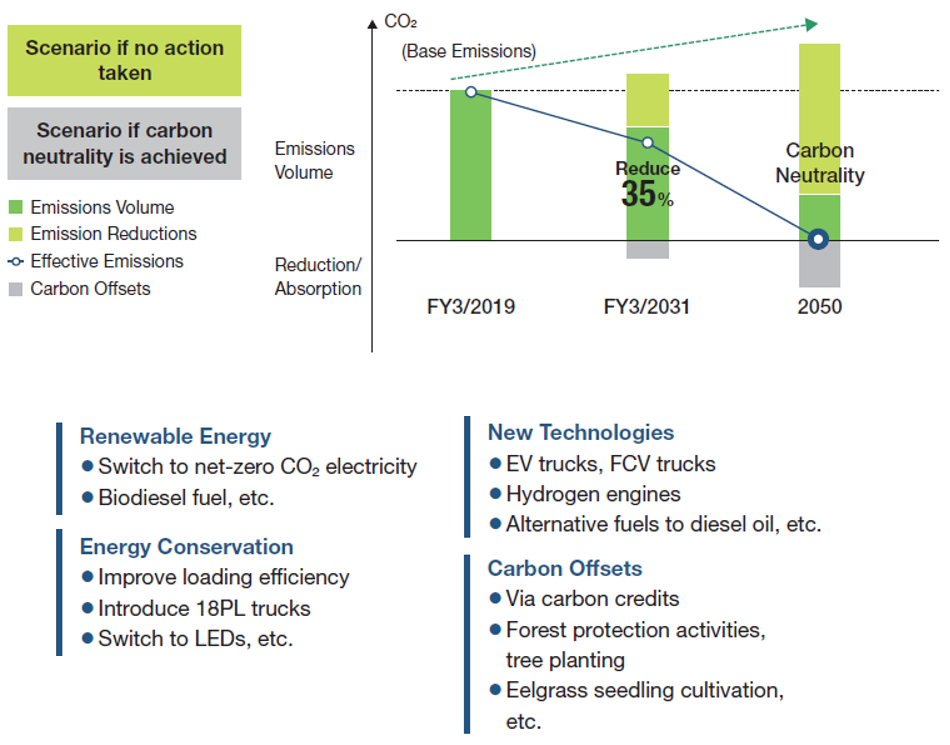
We completed the switch to CO2-free electricity for all contracted electricity by the end of FY3/2025 in an effort to achieve carbon neutrality. We also achieved our 20% reduction target in CO2 emissions for FY3/2025 compared with FY3/2019 through fuel-efficiency improvements and other energy-saving initiatives, regular vehicle replacement, and the partial introduction of biodiesel fuel and EV trucks. Lower operating levels at certain subsidiaries also contributed to this achievement. Our reduction rate was 24.7% excluding this factor.
Looking ahead, we expect the Group to expand operations and subsidiaries to recover. To this end, we intend to reduce CO2 emissions further by switching to electric vehicles for our business vehicles, installing solar panels, and implementing other energy conservation measures..
Actual CO2 Emissions (Unit: t-CO2e)
| FY3/2025 | Scope | Achievement Against Goals |
|---|---|---|
| 101,978t-CO2e | Scope1 | 35.2% reduction compared with FY3/2019 levels |
| 23,915t-CO2e | Scope2 |
- Calculated in line with the GHG protocol
- Scope 2 uses the market-based method
CO2 Emission Reduction Targets
| Date | Target | Target | Scope |
|---|---|---|---|
| FY3/2028 | 28% reduction (vs. FY3/2019) | Konoike Transport Co., Ltd. and domestic consolidated subsidiaries | Scope1 and Scope 2 |
| FY3/2031 | 35% reduction (vs. FY3/2019) | ||
| 2050 | Targeting carbon neutrality | ||
Overview of CO2 Emissions Reduction